Professor Caixia Gao’s research team at the Institute of Genetics and Developmental Biology, Chinese Academy of Sciences, has developed a platform for designing synthetic plant immune receptors that recognize selected pathogen proteins. Our study, titled “Programmable design of synthetic plant immune receptors for pathogen protein recognition,” was published online as a Science First Release on July 24, 2026 (DOI: 10.1126/science.aee1792).
Our work introduces a concept of programmable plant synthetic immunity. By integrating artificial intelligence–assisted protein design, modular immune receptor engineering, and directed evolution in plants, the researchers established a platform for creating synthetic plant immune receptors (SPIRs) that can be programmed to recognize selected pathogen proteins.
Crop production faces threats from plant pathogens. Traditional disease-resistance breeding relies heavily on natural plant resistance genes that encode immune receptors adapted to particular pathogens. However, rapidly evolving pathogens frequently overcome these natural defenses, and the limited diversity of naturally occurring immune receptors makes it difficult to develop crops with durable resistance. Most plant disease-resistance genes encode nucleotide-binding leucine-rich repeat receptors (NLRs) that detect pathogen proteins and activate defense responses. However, conventional resistance breeding relies on the discovery of natural resistance genes, which are limited in number and can be overcome by rapidly evolving pathogens. Designing immune receptors against specific pathogen targets could provide a faster and more flexible alternative.
Our team focused on NLR receptors containing compact and modular integrated domains that directly recognize pathogen proteins. We used AlphaFold 3 to predict pathogen protein structures, BindCraft to design target-binding proteins, and HelixFold 3 to evaluate candidate interactions. The designed binders were then inserted into the rice immune receptor Pikm-1, replacing its natural integrated domain and creating receptors with new recognition specificities.
As an initial test, we designed 48 SPIRs targeting the coat protein of Potato virus Y. Eleven specifically recognized the target and activated plant immune responses. The platform was subsequently applied to proteins from 13 important plant viruses, as well as bacterial, fungal and oomycete pathogens.
In total, we designed and tested 391 SPIRs, of which 71 specifically recognized their intended pathogen proteins and activated immune responses, representing an overall success rate of 18.2%. These results demonstrate that AI-assisted de novo protein design can be used to create functional plant immune receptors.
Some initial SPIR designs exhibited weak immunogenicity or unintended autoactivation in the absence of their targets. To improve their performance, we combined the SPIR platform with GRAPE, an in planta directed evolution system previously developed in our laboratory. This approach enhanced target-dependent immune activity while reducing background activation, establishing a complete design–build–test–evolve workflow.
The optimized SPIRs showed high target specificity and could be combined through gene stacking to recognize multiple pathogen proteins. Importantly, transgenic plants expressing selected SPIRs displayed resistance to the corresponding viral infections, demonstrating the potential of this technology for crop improvement.
The SPIR platform represents a shift from discovering natural resistance genes to designing plant immune receptors on demand. This strategy may provide a rapid response to emerging plant diseases, newly evolved pathogen variants, and pathogens for which suitable natural resistance genes are unavailable. It also offers a potential route toward multiplexed and broad-spectrum disease resistance in crops.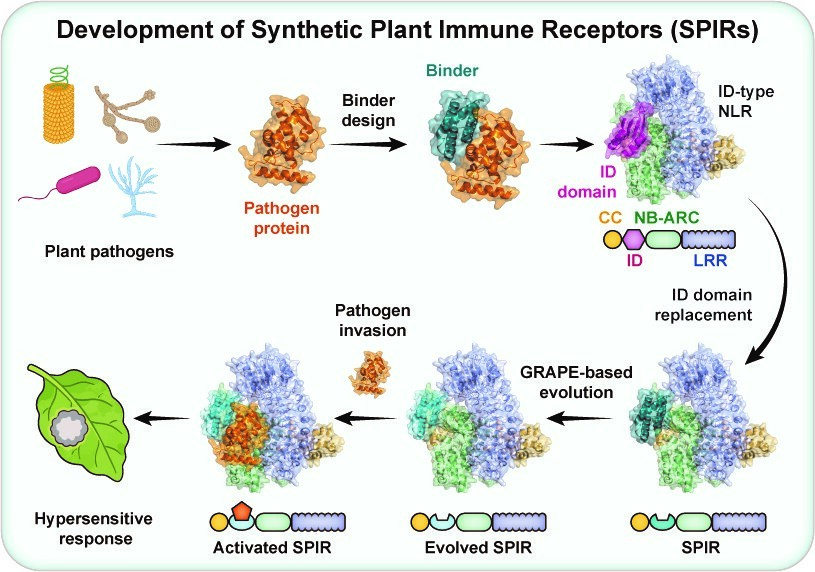
Complete design–build–test–evolve workflow of SPIRs
附件:

 京公网安备 11010502049531号